
What is the default attribution model used in Matomo?
By default, Matomo uses Last Non-Direct attribution for standard Goal and Ecommerce conversion reporting. This means conversions are credited to the most recent known non-direct referrer or campaign, even if the visitor returns directly to the website before converting.
Last Non-Direct attribution
A Last Non-Direct source may include a search engine, referring website or tracked marketing campaign. Direct Entry generally refers to visits where Matomo does not identify a referring source, such as when someone types your website address into their browser or uses a bookmark.
If a visitor returns directly after an earlier non-direct visit, Matomo credits the conversion to the previous non-direct source, provided the relevant attribution information is still available.
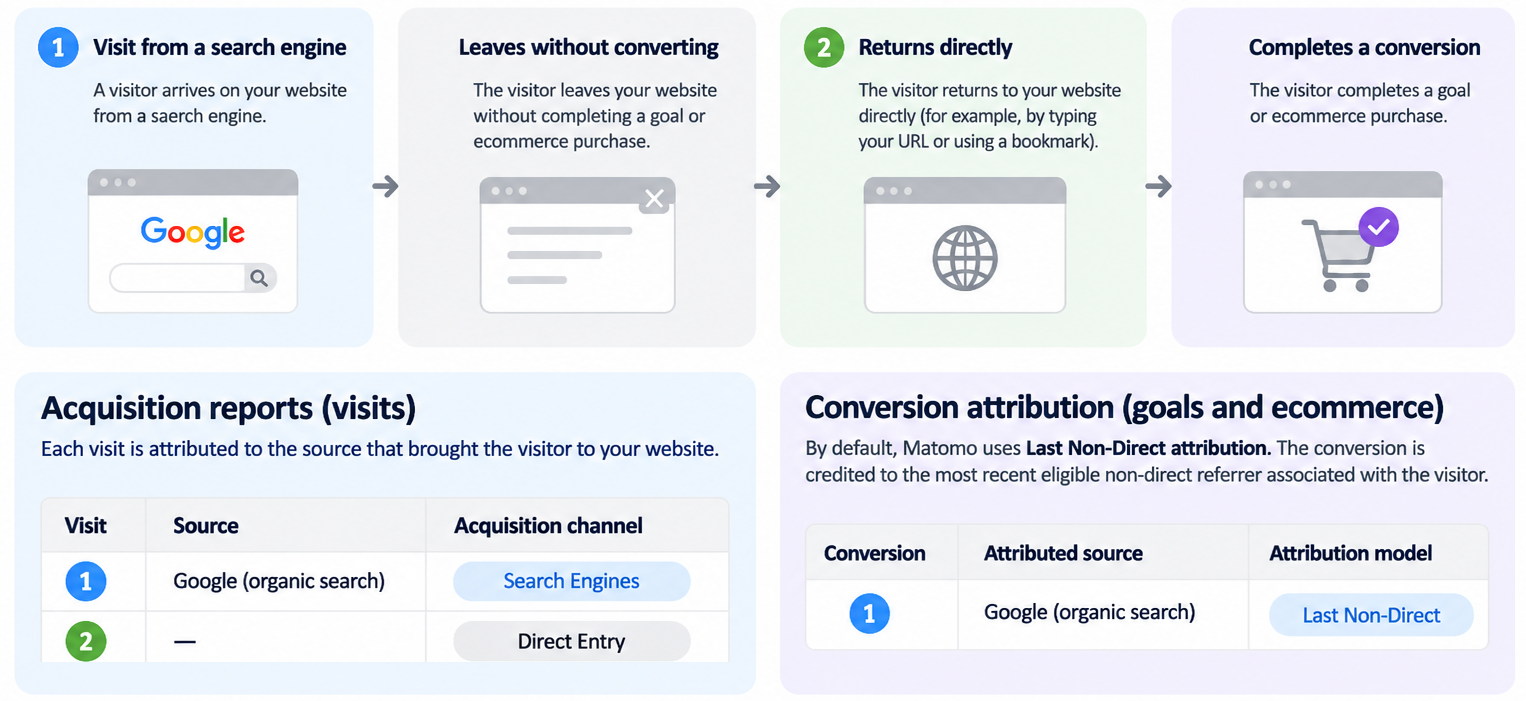
How Matomo uses attribution information
Matomo distinguishes between the acquisition source of a visit and the source credited for a conversion.
- Visit acquisition source: Describes how the visitor arrived for that particular visit, such as through a search engine, campaign, referring website or Direct Entry.
- Conversion attribution source: Identifies the referrer or campaign credited for the conversion. Under Last Non-Direct attribution, this may be a source from an earlier visit rather than the current Direct Entry visit.
As illustrated above, the returning visit can appear under Direct Entry in Acquisition reports, while the conversion is credited to the earlier Search Engine referral. Both results can be correct because visit acquisition and conversion attribution answer different questions.
What affects conversion attribution
Matomo’s ability to attribute conversions to earlier interactions depends on the tracking configuration and whether relevant attribution information remains available.
Tracking configuration and browsers
1. Changing the attribution model
Matomo provides an optional tracking setting to attribute conversions to the first referrer instead of the default Last Non-Direct source. This changes how standard conversion attribution is configured.
It should not be confused with selecting attribution models in Multi-Channel Conversion Attribution, which allows you to analyse how different interactions contribute to conversions using alternative attribution models.
2. Browser behaviour
Certain browsers may restrict or remove referrer information and URL tracking parameters. This can prevent Matomo from identifying the original acquisition source, resulting in more visits classified as Direct Entry. See Why is search and referral traffic decreasing while Direct Entry increases?
3. Link attributes
Links using rel="noreferrer" prevent the browser from passing referrer information to the destination website.
4. No referrer information
If Matomo has no eligible previous non-direct referrer or campaign information available when the conversion is recorded, the conversion cannot be credited to an earlier non-direct source and may appear as Direct Entry.
Visitor identification and attribution information
Matomo can attribute a conversion to an earlier source only when the relevant attribution information is available when the conversion is tracked.
1. First-party cookies
These cookies help Matomo recognise returning visitors and retain information about previous referrers or campaigns. If cookies are unavailable, cleared or restricted, earlier attribution information may be lost.
2. Matomo privacy settings
Certain privacy settings, such as disabling cookies or anonymising referrer information, can affect the acquisition information Matomo collects and retains.
3. User ID tracking
User IDs can help Matomo identify activity associated with a signed-in user, but it does not automatically guarantee that earlier referrer or campaign information will be available for conversion attribution.
When earlier attribution information is unavailable, a conversion may instead be credited to the source of the current visit, including Direct Entry.