
Analyse Cohorts
Use Cohorts in Matomo to analyse visitor behaviour, compare retention between cohorts and investigate whether website updates, campaigns or new content may have influenced engagement. For an overview of the feature and its availability, see What does Cohorts do?
This guide explains how to read and interpret the Cohorts report, compare retention and engagement, and apply segments to analyse specific groups of visitors.
View the Cohorts Report
- In Matomo, navigate to Visitors > Cohorts.
- The Cohorts report displays a graph and table based on the most recent cohorts for the selected period.

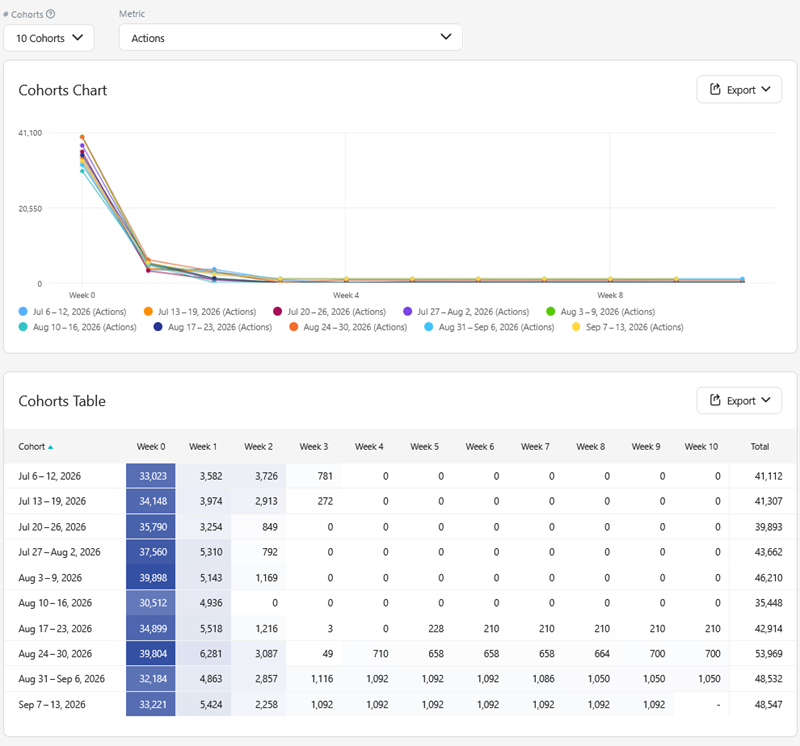
Select a metric and date range for analysis
-
Use the date selector to view cohorts by day, week, month or year. Cohorts are defined by the selected reporting period. For example, selecting a monthly period groups visitors by the month of their first visit, while selecting a weekly period groups them by the week of their first visit.
-
Click the Cohorts selector to change how many cohorts are shown and open the Metric dropdown to choose what you want to measure.
-
For example, select Returning Visitors % to show the percentage of visitors in a cohort who returned during the selected period. This is the default metric to measure visitor retention.

-
Select the metric that best matches your objective, then compare cohorts across equivalent periods to identify changes in visitor behaviour.
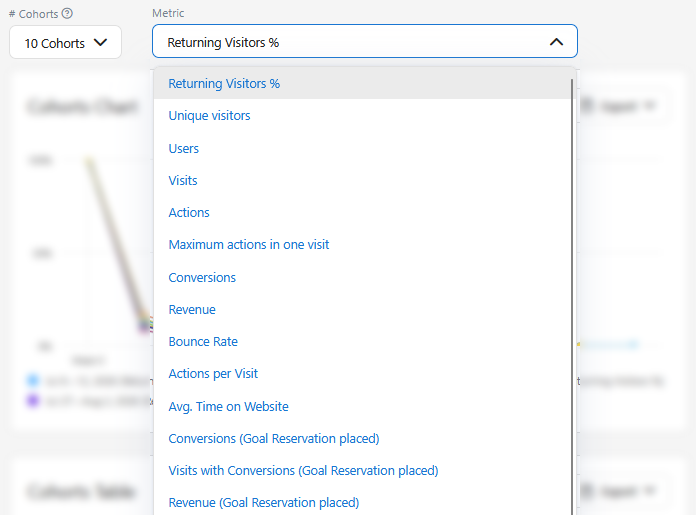
Depending on the metrics available in your report, you may be able to analyse conversions, goals and ecommerce revenue.
How to read the Cohorts report
The graph and table present the same data in different ways. The graph shows trends over time, while the table lets you compare individual cohorts and their activity during subsequent periods. Consider the expected behaviour of your visitors, cohort size and the selected metric when interpreting results.
In the table report:
- Rows represent cohorts. Each row groups visitors according to when they first visited your website.
- Columns represent periods after acquisition. For a daily report, Day 0 is the day visitors first arrived, Day 1 is the following day, and so on. For a monthly report, Month 0 is the acquisition month, Month 1 is the following month, and so on.
- Cells display the value. The value for the selected metric recorded in that cohort during the corresponding period.
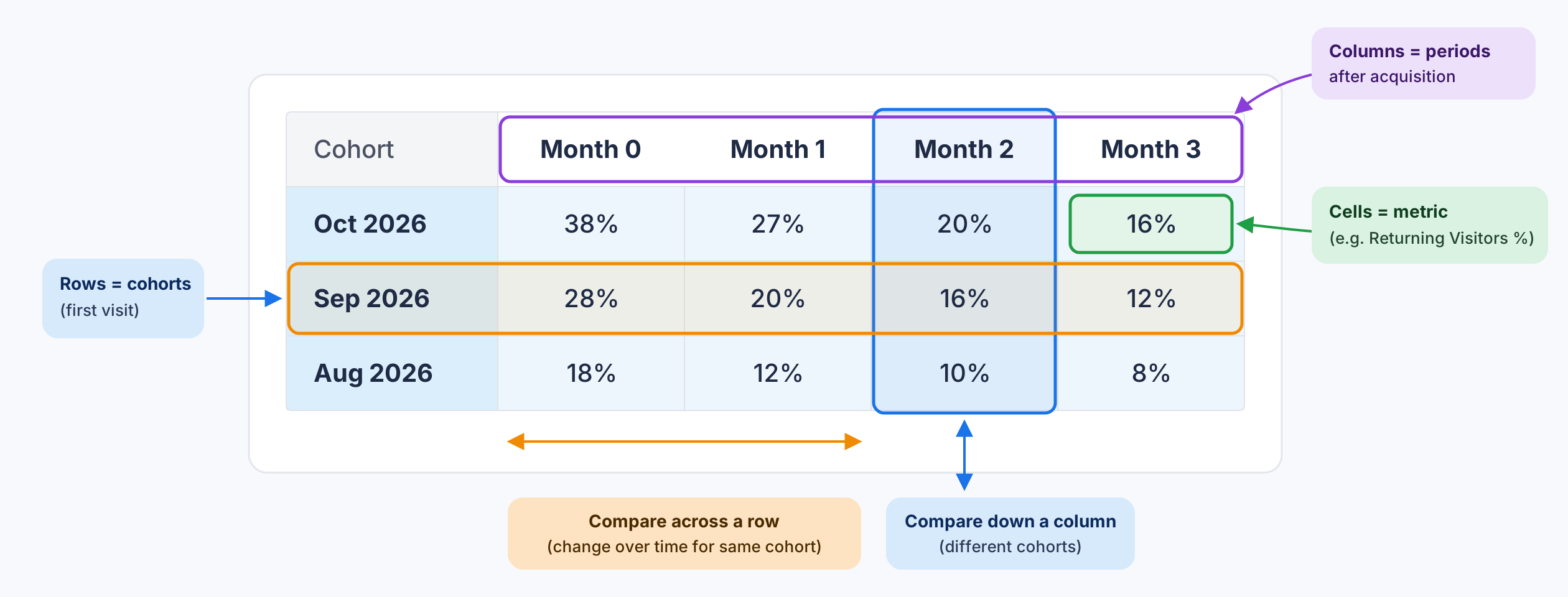
You can compare the report in two ways:
- Across a row: See how a particular cohort’s behaviour changes over time.
- Down a column: Compare different cohorts at the same point after acquisition.
Note: Matomo remembers your selected metric for future visits to the report. Some visitor-based metrics are available only when viewing cohorts by day or week.
Analyse retention and engagement
The Cohorts report helps you identify patterns in how visitors return to and interact with your website. When comparing cohorts, look for:
- Differences between older and newer cohorts: Compare cohorts at the same point after acquisition to identify whether retention or engagement appears to be improving.
- Changes in activity: Use metrics such as Actions or Bounce rate to examine whether visitors continue interacting with your website over subsequent periods.
- Unusual patterns: Investigate cohorts with noticeably higher or lower retention or engagement than others.
There is no universal benchmark for good visitor retention. What constitutes a positive result depends on your website’s purpose and how frequently you expect visitors to return.
Example: Evaluate a website change
After launching a highly requested website feature, you can use the Cohorts report to investigate whether visitor retention and activity have changed since its release. Compare cohorts acquired before and after the release at equivalent points after acquisition.
If newer cohorts show higher retention or activity, this may suggest that the feature had a positive impact. However, other factors, such as marketing campaigns or seasonal changes, may also influence visitor behaviour.
Example: Investigate an underperforming cohort
If you are running an ecommerce website and notice that visitors acquired during a particular period rarely return, creating a segment for that cohort is useful to examine behaviour through other Matomo reports.
Compare an underperforming cohort’s activity with that of a cohort whose visitors returned more frequently and made repeat purchases. Apply segments to identify differences in traffic sources, landing pages, campaigns, devices, and visitor behaviour, such as which pages visitors viewed and whether they completed key actions.
Apply segments to the Cohorts report
You can apply segments to the Cohorts report to analyse retention and engagement for specific visitor groups. For example, segment visitors by traffic source to investigate whether visitors from organic search return more frequently than those from paid campaigns.
- To analyse a particular visitor group, create a custom segment using the conditions you want to investigate.
- Open Visitors > Cohorts and use the top segment selector to select and apply a segment to the report.
- Select Returning Visitors % or Actions and examine how the group’s behaviour changes over time.
You can also use segments to analyse visitors assigned to an A/B test variation.
Create a segment from a cohort
In addition to applying segments to the Cohorts report, you can create a segment for an individual cohort and use it to analyse that group’s behaviour in other Matomo reports. For example, create a segment containing visitors whose first visit was on 14 Sep 2026.
- In the Cohorts table report, identify the cohort you want to explore and hover over the row.
- Click the icon beside the cohort label to open the Segmented Visitor Log.

- When the visitor log report opens, click the three-dot menu and select Add this segment to Matomo.

- Matomo opens the segment editor in a new tab with the selected cohort’s segment definition already filled in.

- Save the segment and apply it to other Matomo reports to analyse that cohort’s behaviour in more detail.
View historical Cohorts reports
In Matomo On-Premise, you can invalidate and reprocess historical data to generate Cohorts reports for earlier periods, such as the previous three months. Refer to the guide for instructions on reprocessing historical reports.
Configure tracking for Cohorts
In most cases, Cohorts works with the Matomo JavaScript tracker without additional configuration. If you use another tracker, such as the PHP tracker or tracking within a mobile app, additional configuration is required.
The Cohorts feature relies on Matomo recognising returning visitors and identifying their previous visits. To ensure visitors are recognised across visits, your tracker must send a consistent visitor identifier using the _id, cid, or uid tracking parameter.
Depending on your tracking implementation, you may need to store and reuse the visitor identifier in subsequent tracking requests. For example, the Matomo JavaScript tracker uses a cookie to recognise returning visitors.